
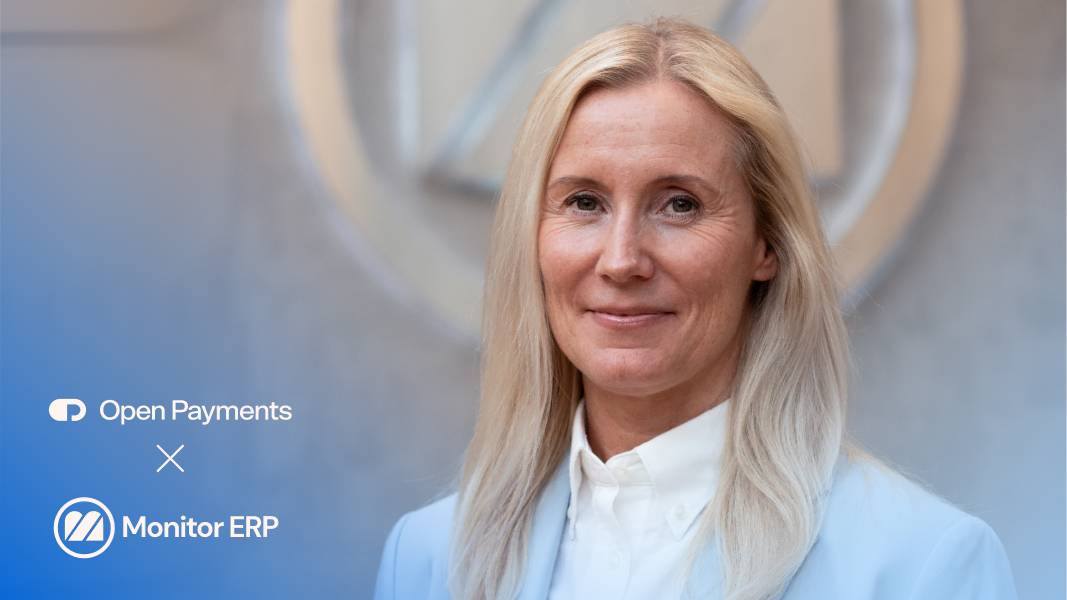
When an ERP is expected to support both small manufacturers and global groups, banking cannot sit outside the system. For Monitor, that means working across complexity, scale and structure – with the right partner in place.
“The expectations are changing quickly,” says Grethe Åsheim Norrby, Product Manager for Finance at Monitor. “Customers don't just want digitalisation, they expect processes to be automated end to end.”
From file handling to embedded flows
Before working with Open Payments, payments in Monitor were largely handled through files. Customers uploaded payment files to their bank and downloaded account statements to reconcile transactions back in the ERP.
“It involved a lot of manual steps,” Grethe explains. “Both for our customers and for us as a system provider.”
From Monitor's perspective, supporting individual bank requirements directly inside the ERP was resource-intensive. Banks changed formats, rules and technical details over time, and every change required monitoring and updates.
“It's complex work to maintain all those connections yourself. And it takes focus away from developing the ERP itself,” Grethe notes.
A partner built for both old and new banking
When evaluating banking API providers in 2022, Monitor had specific requirements that ruled out the competitors: a complete solution with technical capabilities and international ambitions to match their own global footprint.
“We needed a solution that could handle the new technology opened up by PSD2, but also support the legacy formats our customers still relied on,” Grethe explains. What ultimately distinguished Open Payments was their holistic approach:
"They supported both old and new technology, as well as all types of payments – inbound and outbound payments, foreign and domestic, and also fetching bank statements and payment confirmations.”
Payments part of the ERP experience
With Open Payments integrated, banking functionality moved directly into Monitor's ERP workflows. Customers could now initiate payments, sign them with BankID, reconcile accounts digitally and view balances in real time, without leaving the system.
“Payments inside the ERP are much simpler now, with the biggest benefit for our customers being time,” says Grethe. “All the manual uploading and downloading is gone. And with more automation, the risk of errors is significantly reduced.”
Security was another key factor. Payments and transaction data are handled through encrypted flows, and sensitive steps such as signing happen directly inside the ERP.
“For this type of functionality, stability and security are absolutely critical. Our customers need to trust the system completely.”
Monitor's customer base ranges from small manufacturers to large groups with complex account structures and international operations. Through Open Payments, the ERP can now support international payments with transparent FX rates and faster settlement, often at lower cost than traditional bank solutions. Customers can see exchange rates and fees in real time before sending a payment, and in many cases pay directly from their main operating account rather than managing multiple currency accounts.
“That reduces both administration and cost,” says Grethe. “And it simplifies daily work for finance teams.”
A stronger foundation for automation
Over time, the way banking is handled inside Monitor has become more predictable and less resource-intensive. With a single infrastructure partner managing the underlying complexity, the focus can stay on developing ERP functionality that supports more automated workflows for customers.
“Working with one partner simplifies things,” says Grethe. “It gives us room to prioritise automation and reflect more on how the product should evolve.”
The collaboration is set up to support ongoing development rather than one-off integrations. Clear responsibilities, stable communication and shared priorities have made it easier to treat banking as a built-in capability, not a separate project.
“A partnership works best when both sides improve each other's products,” Grethe reflects. “That's very much how this collaboration feels. Communication is good, responses are fast, and there's a shared understanding of what we're building – together.”
